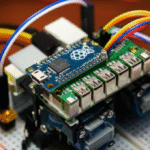
The ELEGO Smart Robot Car Kit is our top all-around recommendation for anyone asking, “What are some beginner-friendly Arduino robotics kits?” It combines straightforward assembly, Arduino-style coding, obstacle avoidance, line tracking, Bluetooth control, and enough expansion potential to keep your first robot from becoming a one-afternoon novelty.
Prefer a gentler introduction? Makeblock mBot offers guided construction and visual programming, while UBTECH JIMU Cosmos suits younger learners who enjoy app-based instructions and expressive servo-driven robots. For servo mechanics, LewanSoul LeArm is the better pick; for walking robots, consider ELEGO Penguin Bot or Freenove Quadruped.
We’ve watched plenty of first robots refuse to move because of one loose ground wire. The culprit is rarely dramatic, but fixing it teaches a powerful lesson: robotics blends code, electronics, mechanics, and patient detective work. A good kit makes that detective work rewarding instead of turning your desk into a museum of disconnected wires.
Key Takeaways
- Best overall: ELEGO Smart Robot Car Kit for Arduino coding, sensors, wireless control, and autonomous driving.
- Best guided learning: Makeblock mBot with Makeblock’s official resources.
- Best for younger creative learners: UBTECH JIMU Cosmos with app-guided building and Blockly coding.
- Best for Arduino project variety: OSOYOO Robot Car Kits, but verify the exact board revision before buying.
- Best for servo mechanics: LewanSoul LeArm.
- Best walking robots: ELEGO Penguin Bot for approachable fun or Freenove Quadruped for a more demanding build.
- Check before ordering: Confirm the controller, batteries, charger, software compatibility, tutorials, replacement parts, and warranty.
- Start with the learning path, not the parts count: A clearly documented kit usually beats a box overflowing with mysterious modules.
- Build skills progressively: Begin with motor tests, then remote control, obstacle avoidance, line following, and custom upgrades.
Table of Contents
- ⚡ Quick Tips and Facts: Choosing Your First Arduino Robotics Kit
- 🤖 What Makes an Arduino Robot Kit Beginner-Friendly?
- Arduino Compatibility, Programming Languages, and IDE Support
- Age Range, Skill Level, and Learning Curve
- Sensors, Motors, Controllers, and Expandability
- 📚 Arduino Robotics Kits: A Short History of Hands-On STEM Learning
- 🏆 The 10 Best Beginner-Friendly Arduino Robotics Kits
- 1. ELEGO Smart Robot Car Kit: Best All-Around Starter Choice
- 2. Makeblock mBot Educational Robot Kit: Best for Guided Learning
- 3. UBTECH Jimu Robot Astrobot Series Cosmos Kit: Best for Creative Building
- 4. OSOYOO Robot Car Starter Kit: Best for Arduino Coding Practice
- 5. LewanSoul Robotic Arm Kit: Best for Mechanical Robotics
- 6. ELEGO Penguin Bot Biped Robot Kit: Best for Walking Robots
- 7. Frenove Quadruped Robot Kit: Best for Advanced Beginner Projects
- 8. SunFounder PiCar-X: Best for Raspberry Pi and Arduino Explorers
- 9. Yahboom Arduino Mini Tank Robot Kit: Best for Tracked-Robot Projects
- 10. DFRobot Maqueen Plus V2: Best for Classroom Robotics
- 🔍 Beginner Arduino Robot Kit Comparison Table
- Best Kits by Age, Programming Experience, and Robot Type
- Wired, Bluetooth, Wi-Fi, and App-Controled Robots Compared
- 🧰 What Components Should an Arduino Robotics Kit Include?
- Arduino Board or Compatible Microcontroller
- Ultrasonic, Infrared, Line-Tracking, and Light Sensors
- DC Motors, Servo Motors, Wheels, and Motor Drivers
- Bluetooth Modules, Wi-Fi Boards, Displays, and Buzzer Modules
- Battery Packs, USB Cables, Screws, Tools, and Spare Parts
- 🛒 Arduino Robot Kit Buying Guide: How to Choose the Right Set
- Set a Realistic Budget and Check the Total Cost of Ownership
- Check Assembly Difficulty, Instructions, and Tutorial Quality
- Verify Software, Library, and Operating-System Compatibility
- Look for Replacement Parts and Reliable Manufacturer Support
- Choose Between a Complete Kit and a Modular Arduino Starter Set
- 💻 Coding and Electronics Skills You Can Learn
- Arduino IDE, C++, Scratch, and Block-Based Programming
- Digital and Analog Inputs, PWM, and Motor Control
- Obstacle Avoidance, Line Following, and Remote Control
- Debuging Wiring, Code, Sensors, and Power Problems
- 🔧 Assembly, Safety, and Easy Access for Beginners
- How Long Does It Take to Build an Arduino Robot?
- Soldering-Free Versus Soldering-Required Robotics Kits
- Battery Safety, Moving Parts, and Safe Workshop Habits
- Making Parts, Manuals, Software, and Community Help Easy to Access
- 🧪 First Arduino Robot Projects to Try
- Build a Remote-Controled Robot Car
- Program an Autonomous Obstacle-Avoiding Robot
- Create a Line-Following Robot
- Add LEDs, Sound Effects, and a Robot Personality
- Upgrade a Starter Robot With a Robotic Arm or Camera
- ⚖️ Arduino Robot Kits Versus Other Educational Robotics Platforms
- Arduino Versus Raspberry Pi Robotics Kits
- Arduino Versus LEGO Mindstorms and SPIKE Prime
- Arduino Versus micro:bit Robot Kits
- Open-Source Hardware Versus Closed Ecosystems
- 💰 Value, Maintenance, and Long-Term Upgrade Potential
- What Affects the Real Cost of an Arduino Robotics Kit?
- Replacement Batteries, Motors, Sensors, and Chassis Parts
- Can a Beginner Kit Grow With Your Skills?
- ✅ Pros and ❌ Cons of Arduino Robotics Kits for Beginners
- 🏫 Arduino Robotics Kits for Kids, Classrooms, Families, and Hobbyists
- Choosing a Kit for Children and Young Learners
- Best Features for Schools and STEM Classrooms
- Family-Friendly Weekend Robotics Projects
- 📖 Reliable Arduino Robotics Learning Resources
- Official Arduino Documentation and Tutorials
- Manufacturer Manuals, GitHub Libraries, and Project Guides
- Arduino Forums, Maker Communities, and Video Tutorials
- ❓ FAQ: Beginner-Friendly Arduino Robotics Kits
- What is the easiest Arduino robot kit for a complete beginner?
- Do Arduino robot kits require programming experience?
- Are Arduino robotics kits suitable for children?
- Is an Arduino robot car kit better than a robotic arm kit for learning?
- Do Arduino robotics kits include batteries and tools?
- Can I use an Arduino Uno with any robotics kit?
- What should I do if my Arduino robot will not move?
- Can beginner Arduino robot kits be expanded later?
- 🏁 Conclusion: Which Beginner Arduino Robotics Kit Should You Choose?
- 🔗 Recommended Links
- ❔ FAQ
- 📑 Reference Links
Quick Tips and Facts: Choosing Your First Arduino Robotics Kit
If you’re comparing beginner robotics kits, our first rule at Robotic Coding™ is simple: choose the kit that gets you building quickly, then keeps teaching you after the first victory lap. Start with our Arduino robotics guide for the platform basics, then use this checklist:
- ✅ Choose guided learning over a giant parts pile. A clear manual, tested code, wiring diagrams, and active documentation often matter more than the number of components.
- ✅ Confirm the controller. A genuine Arduino Uno, an Arduino-compatible Uno R3/R4 board, or a well-documented custom controller should be clearly identified.
- ✅ Prioritize sensors and motor control. Ultrasonic sensors, infrared receivers, line-tracking modules, servo motors, DC motors, and motor drivers create far more learning opportunities than decorative parts.
- ✅ Check the power system. Batteries, chargers, voltage limits, and motor-current requirements can make or break a first project.
- ✅ Look for expansion ports. A robot that supports extra sensors can grow with your skills instead of becoming a very expensive paperweight with wheels.
- ✅ Treat “easy assembly” claims cautiously. The competing RevisionTown guide calls the ELEGO Project Smart Robot Car “very easy to assemble,” while also warning that assembly time for some kits can stretch beyond advertised estimates. That distinction matters.
- ✅ Expect some debugging. Arduino robotics teaches electronics, programming, mechanics, and patience. The robot may not move because of one loose ground wire. We’ve all blamed the code first. The wire usually wins.
- ✅ Start with a two-wheel robot car if you want fast results. Choose a robotic arm, biped, or quadruped if your main interest is servos, balance, or mechanical movement.
- ✅ Avoid unclear board specifications. The RevisionTown summary describes the OSOYOO kit as both Arduino UNO R3-based and equipped with a “High-Quality UNO R4 Arduino board.” Verify the actual board in the manufacturer’s documentation before buying.
- ✅ Use official documentation when sources disagree. Arduino’s official documentation is more dependable for board capabilities than a retailer listing or a copied specification table.
A fast decision matrix
| Your priority | Best starting direction | Why |
|---|---|---|
| First autonomous robot | ELEGO or OSOYOO robot car | Sensors, motors, obstacle avoidance, and line following |
| Visual coding for children | Makeblock mBot or UBTECH JIMU | Block-based programming and guided assembly |
| Servo and mechanical control | LewanSoul LeArm | Teaches joints, angles, gripping, and sequencing |
| Entertaining demonstrations | ELEGO Penguin Bot | Dancing, sounds, following, and obstacle detection |
| Walking robotics | ELEGO Penguin Bot or Frenove Quadruped | Introduces balance, gait, and multi-servo coordination |
| Broad electronics practice | ELEGO Super Starter Kit UNO R3 | Many modules for experiments beyond one robot chassis |
| Expansion and custom coding | Frenove or a modular Arduino kit | More ports, code libraries, and room for modifications |
One question will keep resurfacing: is the “best” kit the one with the most parts, or the one that teaches the clearest first lesson? Keep that thought handy; the comparison table later gives it a proper answer.
What Makes an Arduino Robot Kit Beginner-Friendly?
A beginner-friendly Arduino robotics kit is not merely a box containing a circuit board, screws, and optimistic marketing. It should reduce avoidable friction while leaving enough control for you to understand what the robot is doing.
The strongest kits combine:
- A documented microcontroller
- Straightforward mechanical assembly
- Clearly labeled wiring
- Example programs that actually work
- Sensors that produce visible results
- A path toward modification
The Arduino platform is popular because it combines accessible hardware with an approachable programming environment. Arduino sketches typically use a simplified C/C++ structure, while the ecosystem provides libraries, examples, and community support. We cover the programming side in our Coding Languages category.
Arduino compatibility, programming languages, and IDE support
Look for one of these setups:
| Controller type | Beginner experience | What to verify |
|---|---|---|
| Arduino Uno R3 | Excellent for tutorials and basic sensors | Genuine or compatible board, USB connection, pin layout |
| Arduino Uno R4 | Strong modern option | Library and shield compatibility |
| Arduino-compatible custom board | Can be convenient | Board support package, schematic, sample code |
| Makeblock controller | Friendly within its ecosystem | Arduino IDE support and board-specific documentation |
| Raspberry Pi-based controller | Powerful but more complex | Operating system, Python libraries, wireless setup |
| Proprietary controller | Potentialy simple | Whether you can access code and replace parts |
A kit that says “Arduino-compatible” should explain how it is compatible. Does it use the Uno pinout? Can you select the board in Arduino IDE? Are the motor and sensor libraries available? Does the manufacturer publish code on GitHub?
The official Arduino IDE software documentation explains board selection, library installation, and sketch uploading. Those three tasks form the backbone of most beginner projects.
Why board clarity matters
The OSOYOO description summarized by RevisionTown illustrates a common problem: one listing refers to an Arduino UNO R3 chipset, while another feature line mentions a UNO R4 board. Those are not interchangeable labels. The Uno R4 family uses a different microcontroller architecture from the Uno R3, so board-specific libraries and pin behavior deserve checking.
Our advice: trust the manufacturer’s current product page, downloadable manual, schematic, and code repository over a marketplace bullet list.
Age range, skill level, and learning curve
Age ratings are useful, but they are not a universal difficulty scale.
| Learner profile | Suitable kit traits | Potential stumbling block |
|---|---|---|
| Young child with adult help | Snap-fit parts, app instructions, block coding | Small parts and battery handling |
| Preteen beginner | Guided robot car or mBot-style kit | Reading wiring diagrams |
| Teen or adult beginner | Arduino Uno robot car or starter electronics kit | Debuging libraries and power |
| Experienced programmer new to hardware | Open Arduino board and modular sensors | Mechanical assembly and voltage |
| Family project | Short build stages and visible effects | Sharing the USB cable and screwdriver |
UBTECH’s JIMU Cosmos kit is aimed at younger learners and uses 3D animated building instructions plus Blockly-style coding. Makeblock’s mBot takes a more structured educational route. ELEGO and OSOYOO robot cars tend to offer more direct exposure to Arduino-style wiring and code.
The best age rating is the one that matches the learner’s patience, reading ability, and willingness to troubleshoot, not just the number printed on the box.
Sensors, motors, controllers, and expandability
A robot becomes educational when its inputs and outputs connect in a meaningful loop:
- A sensor gathers information.
- The microcontroller processes it.
- Code makes a decision.
- A motor, light, buzer, or display responds.
For example:
Ultrasonic sensor detects an object
 ↓
Arduino calculates distance
 ↓
If distance is too close
 ↓
Motor driver reverses one motor
 ↓
Robot turns away
``

That loop introduces concepts from [robotics](https://roboticcoding.com/category/robotics/) and even the foundations of [artificial intelligence](https://roboticcoding.com/category/artificial-intelligence/), although a simple obstacle-avoidance robot is generally rule-based automation rather than machine learning.

#### The minimum useful feature set

For a first mobile robot, we recommend:

- Two geared DC motors
- A dual-channel motor driver
- An ultrasonic distance sensor
- Infrared line-tracking sensors
- An infrared remote receiver
- A Bluetooth or Wi-Fi control option
- A stable battery holder
- Accessible expansion pins

A kit with all eight features can support several projects without forcing you to buy additional electronics immediately.

## Arduino Robotics Kits: A Short History of Hands-On STEM Learning

Arduino began as an accessible open-source electronics platform developed in Italy, and the project’s official [Arduino history page](https://www.arduino.cc/en/about/) describes its roots in making interactive electronics more approachable for students, designers, and hobbyists.

That original spirit explains why Arduino robot kits remain popular: the board is not a sealed black box. You can inspect the pins, change the code, replace the sensor, and ask why the motor behaves like a caffeinated beetle.

### From programmable boards to complete robot kits

Early hobby robotics often required separate purchases:

- Microcontroller board
- Motor driver
- Motors and wheels
- Chassis
- Sensors
- Battery system
- Wires and connectors
- Code examples

Modern kits package those pieces into a more approachable experience. The tradeoff is that some kits hide complexity behind custom boards or apps. That can be helpful for a first hour, but frustrating when you want to understand the underlying electronics.

### Why Arduino robotics still works as a teaching tool

Arduino robot projects naturally connect:

- **Programming:** variables, loops, functions, conditions, and libraries
- **Electronics:** voltage, current, polarity, pull-up resistors, and PWM
- **Mechanics:** torque, traction, gear ratios, balance, and friction
- **Systems thinking:** inputs, decisions, outputs, and feedback
- **Design:** chassis layout, wire management, and iterative testing

We often recommend starting with a simple behavior and adding one capability at a time. A robot that drives forward is useful. A robot that stops when it sees a wall is more interesting. A robot that chooses the clearer direction gives you a small but satisfying lesson in decision-making.

## The 10 Best Beginner-Friendly Arduino Robotics Kits

The products below are not ranked solely by the number of modules. We assess **learning value, documentation, programming access, mechanical difficulty, expandability, and the likelihood that a first-time builder can recover from a mistake**.

### Rating scale

- **9–10:** Excellent beginner experience with strong learning value
- **7–8:** Very good, with manageable limitations
- **5–6:** Useful for a specific learner or project
- **Below 5:** Better suited to experienced builders or niche use

## 1. ELEGO Smart Robot Car Kit: Best All-Around Starter Choice

| Category | Rating / 10 |
|---|---:|
| Beginner friendliness | 9 |
| Mechanical design | 8 |
| Programming access | 9 |
| Sensor and navigation features | 9 |
| Documentation | 8 |
| Expandability | 8 |
| Educational value | 9 |
| Build quality | 8 |
| **Overall** | **8.5** |

Explore the [ELEGO Smart Robot Car Kit on Amazon](https://www.amazon.com/s?k=ELEGO+Smart+Robot+Car+Kit&tag=bestbrands0a9-20&tag=bestbrands0a9-20&tag=bestbrands0a9-20&tag=bestbrands0a9-20) and compare it with the [official ELEGO robotics collection](https://us.elegoo.com/collections/all/robot-kits).

The ELEGO Project Smart Robot Car Kit is a strong first choice when you want a robot that can **move, sense, and respond** without requiring a full electronics lab.

According to the RevisionTown summary, the kit includes **24 modules**, an Arduino-compatible controller, an infrared remote, obstacle avoidance, line tracking, mobile control through the ELEGO BLE Tool app, an HC-08 Bluetooth module, rechargeable batteries, and modified XH2.54 connectors.

### Why the ELEGO car teaches quickly

A beginner can progress through a satisfying sequence:

1. Assemble the chassis.
2. Test the motors.
3. Upload a basic movement sketch.
4. Operate the car with the infrared remote.
5. Add obstacle avoidance.
6. Try line tracking.
7. Control the robot from a phone.
8. Modify the behavior in code.

That sequence moves from **output control** to **sensor input** and finally to **autonomous behavior**.

The [Arduino motor control reference](https://docs.arduino.cc/learn/microcontrollers/analog-output/) helps explain how pulse-width modulation can vary motor speed. Beginners do not need to master PWM on day one, but it becomes valuable when one wheel spins faster than the other.

### Strengths

- ✅ Multiple operating modes in one chassis
- ✅ Good introduction to motors and sensors
- ✅ Bluetooth and infrared control options
- ✅ Line following and obstacle avoidance create visible results
- ✅ Arduino-compatible learning path
- ✅ Connectors can reduce wiring confusion

### Drawbacks

- ❌ The exact board revision may vary by seller or production batch
- ❌ Bluetooth app support can depend on phone operating-system compatibility
- ❌ Robot cars can expose power issues quickly when motors start
- ❌ Some learners may outgrow the prewritten modes without additional projects

### Our practical verdict

Choose this kit if you want the **best balance of guided assembly, Arduino coding, and autonomous robot behavior**. It is less ideal if your main goal is learning breadboard electronics from individual components, where the ELEGO Super Starter Kit is a better companion.

> 👉 **CHECK PRICE on:** [ELEGO Smart Robot Car Kits on Amazon](https://www.amazon.com/s?k=ELEGO+Smart+Robot+Car+Kit&tag=bestbrands0a9-20&tag=bestbrands0a9-20&tag=bestbrands0a9-20&tag=bestbrands0a9-20) | [ELEGO Official Robotics](https://us.elegoo.com/collections/all/robot-kits)

## 2. Makeblock mBot Educational Robot Kit: Best for Guided Learning

| Category | Rating / 10 |
|---|---:|
| Beginner friendliness | 9 |
| Mechanical design | 9 |
| Programming access | 8 |
| Sensor and navigation features | 8 |
| Documentation | 9 |
| Expandability | 8 |
| Educational value | 9 |
| Build quality | 9 |
| **Overall** | **8.6** |

See the [Makeblock mBot on Amazon](https://www.amazon.com/s?k=Makeblock+mBot+Arduino+robot&tag=bestbrands0a9-20) and the [official Makeblock mBot page](https://www.makeblock.com/pages/mbot-robot-kit-robot-kit%20-robot-kit-robot-kit-robot-kit).

Makeblock’s mBot is designed to feel more like assembling a construction system than wiring an improvised machine. That is a compliment. Fewer early wiring mistakes mean more time spent learning what the robot can do.

The RevisionTown summary describes mBot as a **3-in-1 educational robot** with block-based building and compatibility with Arduino Mega 2560 development through the Me Auriga board. It also notes an advertised assembly time of about 45 minutes, while warning that real assembly may take several hours.

### Why mBot suits guided learners

mBot typically offers a smoother path for learners who appreciate:

- Visual programming
- Structured lessons
- A tidy chassis
- Modular accessories
- Familiar construction-style assembly
- A gradual transition toward Arduino IDE

The official [Makeblock education resources](https://education.makeblock.com/) provide project ideas and classroom-oriented materials.

### Programming progression

A useful mBot learning ladder looks like this:

```text
Block-based commands
 ↓
Sensor-triggered behaviors
 ↓
Variables and conditions
 ↓
Arduino IDE sketches
 ↓
Custom sensors and hardware
``

That progression is valuable for children and adults who find raw C++ syntax intimidating at first.

### Strengths

- ✅ Friendly construction experience
- ✅ Strong visual programming entry point
- ✅ Good educational documentation
- ✅ Modular design
- ✅ Can transition toward Arduino-style development
- ✅ Suitable for classrooms and family projects

### Drawbacks

- ❌ The ecosystem can feel less open than a bare Arduino Uno
- ❌ Battery requirements should be checked before assembly
- ❌ Advanced users may find the default projects restrictive
- ❌ The competing summary reports no dedicated warranty

### Our practical verdict

Pick mBot when **ease of construction and guided learning** matter more than immediate access to every low-level electronics detail. It is a polished starting point, though experienced Arduino users may prefer a more conventional Uno-based robot car.

> 👉 **CHECK PRICE on:** [Makeblock mBot on Amazon](https://www.amazon.com/s?k=Makeblock+mBot+robot&tag=bestbrands0a9-20&tag=bestbrands0a9-20&tag=bestbrands0a9-20) | [Makeblock Official](https://www.makeblock.com/pages/mbot-robot-kit-robot-kit%20-robot-kit-robot-kit-robot-kit)

## 3. UBTECH JIMU Robot Astrobot Series: Cosmos Kit: Best for Creative Building

| Category | Rating / 10 |
|---|---:|
| Beginner friendliness | 9 |
| Mechanical design | 9 |
| Programming access | 8 |
| Sensor and navigation features | 8 |
| Documentation | 9 |
| Expandability | 7 |
| Educational value | 9 |
| Build quality | 8 |
| **Overall** | **8.4** |

Browse [UBTECH JIMU robot kits on Amazon](https://www.amazon.com/s?k=UBTECH+JIMU+Cosmos+robot+kit&tag=bestbrands0a9-20) and visit the [UBTECH robotics site](https://www.ubtrobot.com/).

The JIMU Cosmos Kit takes a different route from Arduino robot cars. Instead of emphasizing breadboard wiring and wheel control, it focuses on **snap-together construction, app-guided assembly, servo movement, and creative behaviors**.

The supplied summary reports more than 384 parts, commonly described as 387 pieces, along with five servo motors, LED lights, a control box, a USB-rechargeable battery, sensors, a Bluetooth speaker, and Blockly-based coding.

### What makes JIMU approachable

The 3D animated building instructions can be particularly helpful for learners who struggle with flat diagrams. The app-guided system shows how parts fit together, while Blockly-style coding avoids the immediate challenge of punctuation-heavy text programming.

Reported capabilities include:

- Object pickup
- Obstacle navigation
- Light control
- Sound effects
- Custom poses and behaviors
- Pose, Record, Play functions
- Guided coding challenges

### The tradeoff

JIMU’s polished ecosystem can conceal some underlying electronics. That is excellent for motivation, but less ideal if your goal is to learn exactly how an ultrasonic sensor connects to an Arduino pin.

The kit is best viewed as a **robotics and computational-thinking platform**, not a conventional Arduino Uno electronics kit.

### Strengths

- ✅ Excellent visual assembly experience
- ✅ Attractive, expressive robot behavior
- ✅ Strong fit for younger learners
- ✅ Servo-based movement introduces articulated robotics
- ✅ Blockly programming reduces the initial coding barrier

### Drawbacks

- ❌ Less direct Arduino Uno-style wiring practice
- ❌ App and ecosystem support should be checked for current device compatibility
- ❌ Fewer opportunities for low-level modification than open hardware
- ❌ The supplied summary reports no warranty

### Our practical verdict

Choose Cosmos when the learner needs **visual guidance, creativity, and immediate personality**. Choose ELEGO or OSOYOO when the learner specifically wants Arduino IDE, wiring, and sensor-level experimentation.

> 👉 **CHECK PRICE on:** [UBTECH JIMU Cosmos Kits on Amazon](https://www.amazon.com/s?k=UBTECH+JIMU+Cosmos+Kit&tag=bestbrands0a9-20&tag=bestbrands0a9-20&tag=bestbrands0a9-20) | [UBTECH Official Website](https://www.ubtrobot.com/)

## 4. OSOYOO Robot Car Starter Kit: Best for Arduino Coding Practice

| Category | Rating / 10 |
|---|---:|
| Beginner friendliness | 8 |
| Mechanical design | 8 |
| Programming access | 9 |
| Sensor and navigation features | 9 |
| Documentation | 8 |
| Expandability | 8 |
| Educational value | 9 |
| Build quality | 7 |
| **Overall** | **8.1** |

Explore [OSOYOO robot car kits on Amazon](https://www.amazon.com/s?k=OSOYOO+Arduino+robot+car+kit&tag=bestbrands0a9-20&tag=bestbrands0a9-20&tag=bestbrands0a9-20&tag=bestbrands0a9-20) and the [OSOYOO official website](https://osoyoo.com/).

The OSOYOO robot car starter kit is appealing because it provides a broad set of driving modes: smartphone control, infrared control, Wi-Fi control, line following, collision detection, obstacle avoidance, and object-motion following.

### Important board-version caution

The competing RevisionTown summary contains a specification conflict, describing the kit as Arduino UNO R3-based while also mentioning a “High-Quality UNO R4 Arduino board.” That is exactly the kind of discrepancy we want beginners to catch before ordering.

Check:

- Product photographs
- Current manual
- Board marking
- Firmware instructions
- Arduino IDE board selection
- Manufacturer code repository

Do not assume R3 and R4 are interchangeable simply because both carry “UNO” in the name.

### What you can learn

OSOYOO is a useful platform for studying:

- Motor-driver control
- Wireless commands
- Sensor thresholds
- Autonomous decisions
- Line-position correction
- Object tracking
- Robot-control interfaces

The [Arduino serial communication documentation](https://docs.arduino.cc/language-reference/functions/communication/serial/) is especially useful when monitoring sensor readings during debugging.

### Strengths

- ✅ Wide selection of driving modes
- ✅ Good coding potential
- ✅ Wireless and infrared control options
- ✅ Suitable for learners who want to modify behavior
- ✅ Includes rechargeable power components according to the supplied summary

### Drawbacks

- ❌ Board specifications require careful verification
- ❌ Documentation quality may vary by revision
- ❌ No warranty was identified in the supplied summary
- ❌ More modes can mean more setup and troubleshooting

### Our practical verdict

OSOYOO is a strong choice for learners who want **a broad Arduino robot-car playground**, provided they confirm the exact revision and download the matching software before assembly.

> 👉 **CHECK PRICE on:** [OSOYOO Arduino Robot Cars on Amazon](https://www.amazon.com/s?k=OSOYOO+Arduino+robot+car+kit&tag=bestbrands0a9-20&tag=bestbrands0a9-20&tag=bestbrands0a9-20&tag=bestbrands0a9-20) | [OSOYOO Official](https://osoyoo.com/)

## 5. LewanSoul LeArm 6DOF Robotic Arm Kit: Best for Mechanical Robotics

| Category | Rating / 10 |
|---|---:|
| Beginner friendliness | 7 |
| Mechanical design | 9 |
| Programming access | 8 |
| Sensor and navigation features | 5 |
| Documentation | 8 |
| Expandability | 8 |
| Educational value | 9 |
| Build quality | 9 |
| **Overall** | **7.9** |

Find [LewanSoul LeArm kits on Amazon](https://www.amazon.com/s?k=LewanSoul+LeArm+robotic+arm&tag=bestbrands0a9-20&tag=bestbrands0a9-20&tag=bestbrands0a9-20&tag=bestbrands0a9-20) and browse [LewanSoul robotics products](https://www.lewansoul.com/).

A robotic arm teaches a different robotics vocabulary. Instead of asking, “How does my car avoid a wall?” you ask:

- Which servo controls this joint?
- What angle should the shoulder reach?
- How can the claw grip without crushing an object?
- How do several motors coordinate one movement?

The LeArm uses metal brackets, a metal base plate, digital servos, and a gripper. The supplied summary describes it as a 5-axis arm despite the product name referencing 6DOF, so verify the exact current model and servo arrangement before purchase.

### Why arms are educational

A robotic arm provides an intuitive introduction to:

- Servo position commands
- Joint limits
- Coordinate systems
- Repeatable motion sequences
- Gripper control
- Mechanical load and torque
- Inverse-kinematics concepts

It does not roll across the floor, but that is not a weakness if manipulation is your interest.

### Strengths

- ✅ Strong mechanical construction
- ✅ Excellent servo-control lessons
- ✅ App and PC control options
- ✅ More substantial than lightweight plastic arm kits
- ✅ Suitable for scripted pick-and-place tasks

### Drawbacks

- ❌ Batteries are reportedly not included
- ❌ The arm remains in one location
- ❌ Servo calibration can be challenging
- ❌ Exact degrees of freedom should be confirmed by model number
- ❌ No warranty was identified in the supplied summary

### Our practical verdict

Choose LeArm if you want **mechanical robotics and servo programming**, not autonomous navigation. It is a good second project after a simple robot car or a rewarding first kit for mechanically minded learners.

> 👉 **CHECK PRICE on:** [LewanSoul LeArm on Amazon](https://www.amazon.com/s?k=LewanSoul+LeArm+robotic+arm&tag=bestbrands0a9-20&tag=bestbrands0a9-20&tag=bestbrands0a9-20&tag=bestbrands0a9-20) | [LewanSoul Official](https://www.lewansoul.com/)

## 6. ELEGO Penguin Bot Biped Robot Kit: Best for Walking Robots

| Category | Rating / 10 |
|---|---:|
| Beginner friendliness | 8 |
| Mechanical design | 8 |
| Programming access | 8 |
| Sensor and navigation features | 8 |
| Documentation | 8 |
| Expandability | 6 |
| Educational value | 8 |
| Build quality | 8 |
| **Overall** | **7.8** |

See [ELEGO Penguin Bot kits on Amazon](https://www.amazon.com/s?k=ELEGO+Penguin+Bot+Biped+Robot&tag=bestbrands0a9-20&tag=bestbrands0a9-20&tag=bestbrands0a9-20&tag=bestbrands0a9-20) and the [ELEGO official robotics collection](https://us.elegoo.com/collections/all/robot-kits).

The Penguin Bot is designed to make robotics entertaining. It can reportedly follow objects, detect obstacles, follow a single line, play music, sing, dance, respond to an infrared remote, and connect through Bluetooth.

That list is not just party trick territory. A walking robot introduces:

- Servo timing
- Center of gravity
- Foot placement
- Coordinated movement
- Balance
- Gait sequencing

### Why personality helps learning

We’ve seen beginners ignore a technically elegant project because it does nothing visibly fun. Give the robot a dance routine, however, and suddenly the learner wants to change the timing values. Motivation is an engineering resource.

The interchangeable face covers and color choices also help the robot feel personal. That may sound cosmetic, but ownership often encourages experimentation.

### Strengths

- ✅ Entertaining behaviors motivate beginners
- ✅ Introduces biped movement and servo coordination
- ✅ Multiple control modes
- ✅ Includes spare parts and assembly tools according to the supplied summary
- ✅ Good bridge between toy-like interaction and Arduino programming

### Drawbacks

- ❌ Less expandable than a modular robot car
- ❌ Walking can be mechanically sensitive
- ❌ Advanced customization may be limited
- ❌ No warranty was identified in the supplied summary

### Our practical verdict

Pick Penguin Bot when **engagement and movement personality** are the priority. For deeper electronics experiments, pair it with a separate Arduino sensor kit.

> 👉 **CHECK PRICE on:** [ELEGO Penguin Bot on Amazon](https://www.amazon.com/s?k=ELEGO+Penguin+Bot+Biped+Robot&tag=bestbrands0a9-20&tag=bestbrands0a9-20&tag=bestbrands0a9-20&tag=bestbrands0a9-20) | [ELEGO Official](https://us.elegoo.com/collections/all/robot-kits)

## 7. Frenove Quadruped Robot Kit: Best for Advanced Beginners

| Category | Rating / 10 |
|---|---:|
| Beginner friendliness | 6 |
| Mechanical design | 8 |
| Programming access | 9 |
| Sensor and navigation features | 7 |
| Documentation | 8 |
| Expandability | 9 |
| Educational value | 9 |
| Build quality | 8 |
| **Overall** | **7.8** |

Browse [Freenove Quadruped Robot Kits on Amazon](https://www.amazon.com/s?k=Freenove+Quadruped+Robot+Kit&tag=bestbrands0a9-20&tag=bestbrands0a9-20&tag=bestbrands0a9-20&tag=bestbrands0a9-20) and visit the [Freenove official website](https://freenove.com/).

Freenove’s quadruped robot is for learners who look at a wheled chassis and think, “Nice, but where are the legs?”

The supplied summary describes a four-legged robot that can be controlled by wireless remote, PC software, or Android phone. It includes code libraries, expansion ports, spare parts, tools, and a remote that is assembled as part of the project.

### Why quadrupeds are harder

A two-wheel robot often needs two motor outputs. A quadruped may require several servo channels, coordinated timing, and careful mechanical alignment.

A simplified walking cycle might be:

1. Lift one leg.
2. Move it forward.
3. Lower it.
4. Shift the body or prepare the next leg.
5. Repeat with a diagonal pair.
6. Adjust timing for stability.

That is a small introduction to gait planning and multi-actuator coordination.

### Strengths

- ✅ Distinctive walking platform
- ✅ Strong expansion potential
- ✅ Good access to code and libraries
- ✅ Multiple control interfaces
- ✅ Suitable for custom robotics projects

### Drawbacks

- ❌ More difficult mechanical assembly
- ❌ Servo calibration and power demands can challenge beginners
- ❌ Less forgiving than a robot car
- ❌ No warranty was identified in the supplied summary

### Our practical verdict

Choose Frenove if you are an **advanced beginner who wants a serious project**. It is not our first recommendation for a child assembling a robot independently, but it can be an excellent family build with adult support.

> 👉 **CHECK PRICE on:** [Freenove Quadruped Kits on Amazon](https://www.amazon.com/s?k=Freenove+Quadruped+Robot+Kit&tag=bestbrands0a9-20&tag=bestbrands0a9-20&tag=bestbrands0a9-20&tag=bestbrands0a9-20) | [Freenove Official](https://freenove.com/)

## 8. SunFounder PiCar-X: Best for Raspberry Pi and Arduino Explorers

| Category | Rating / 10 |
| :--- | :--- |
| Beginner friendliness | 7 |
| Mechanical design | 8 |
| Programming access | 9 |
| Sensor and navigation features | 9 |
| Documentation | 8 |
| Expandability | 9 |
| Educational value | 9 |
| Build quality | 8 |
| **Overall** | **8.1** |

Explore the [SunFounder PiCar-X on Amazon](https://www.amazon.com/s?k=SunFounder+PiCar-X&tag=bestbrands0a9-20&tag=bestbrands0a9-20) and the [SunFounder official PiCar-X page](https://www.sunfounder.com/products/picar-x).

The SunFounder PiCar-X is not a conventional Arduino Uno kit; it is primarily a Raspberry Pi robotics platform. We include it because many beginners compare Arduino and Raspberry Pi when shopping for their first programmable robot.

### Why it belongs in the comparison

PiCar-X supports camera-based projects, Python programming, remote control, line following, and obstacle avoidance. It provides a route toward computer vision and [robotic simulations](https://roboticcoding.com/category/robotic-simulations/) that a basic Arduino car may not offer.

### Arduino versus Raspberry Pi in this context

| Feature | Arduino robot car | Raspberry Pi robot car |
|---|---|---|
| Startup time | Usually fast | Requires operating-system setup |
| Real-time motor timing | Straightforward | Requires more care |
| Camera and vision | Limited without extra hardware | Stronger platform |
| Programming | Arduino C/C++ | Python and other languages |
| Power management | Often simpler | More demanding |
| Beginner electronics | Excellent | Good, but more layered |
| AI experimentation | Limited | More practical |

### Our practical verdict

Choose PiCar-X if your interest is **Python, cameras, wireless networking, or computer vision**. Choose an Uno-based kit if you want the clearest first lesson in pins, sensors, and motor drivers.

> 👉 **CHECK PRICE on:** [SunFounder PiCar-X on Amazon](https://www.amazon.com/s?k=SunFounder+PiCar-X&tag=bestbrands0a9-20&tag=bestbrands0a9-20) | [SunFounder Official](https://www.sunfounder.com/products/picar-x)

## 9. Yahboom Arduino Mini Tank Robot Kit: Best for Tracked-Robot Projects

| Category | Rating / 10 |
|---|---:|
| Beginner friendliness | 7 |
| Mechanical design | 8 |
| Programming access | 8 |
| Sensor and navigation features | 8 |
| Documentation | 7 |
| Expandability | 8 |
| Educational value | 8 |
| Build quality | 8 |
| **Overall** | **7.7** |

See [Yahboom Arduino tank robot kits on Amazon](https://www.amazon.com/s?k=Yahboom+Arduino+tank+robot&tag=bestbrands0a9-20&tag=bestbrands0a9-20&tag=bestbrands0a9-20) and the [Yahboom official robotics store](https://www.yahboom.net/).

Tracked robots introduce a useful mechanical comparison: tracks can handle some surfaces differently from small wheels, but they also increase friction and place more demand on the motors and battery system.

### What learners can explore

- Differential steering
- Motor-speed matching
- Track tension
- Obstacle crossing
- Wireless control
- Ultrasonic scanning
- Camera or sensor upgrades

### Our practical verdict

A Yahboom tank-style kit is a good choice when the learner wants **a sturdier-looking mobile robot with room for sensors and wireless control**. Check the controller, programming language, and current manual carefully because Yahboom sells several platforms with different hardware.

> 👉 **CHECK PRICE on:** [Yahboom Arduino Tank Robots on Amazon](https://www.amazon.com/s?k=Yahboom+Arduino+tank+robot&tag=bestbrands0a9-20&tag=bestbrands0a9-20&tag=bestbrands0a9-20) | [Yahboom Official](https://www.yahboom.net/)

## 10. DFRobot Maqueen Plus V2: Best for Classroom Robotics

| Category | Rating / 10 |
|---|---:|
| Beginner friendliness | 9 |
| Mechanical design | 8 |
| Programming access | 9 |
| Sensor and navigation features | 8 |
| Documentation | 9 |
| Expandability | 8 |
| Educational value | 9 |
| Build quality | 8 |
| **Overall** | **8.5** |

Explore [DFRobot Maqueen Plus V2 on Amazon](https://www.amazon.com/s?k=DFRobot+Maqueen+Plus+V2&tag=bestbrands0a9-20&tag=bestbrands0a9-20) and visit the [DFRobot official product page](https://www.dfrobot.com/product-2596.html).

Maqueen Plus V2 is generally associated with the micro:bit ecosystem rather than a conventional Arduino Uno setup, but it deserves consideration because many schools compare micro:bit and Arduino robotics platforms.

### Why classrooms like compact robot platforms

A classroom robot needs:

- Fast setup
- Durable connections
- Short activity cycles
- Clear programming interfaces
- Repeatable behavior
- Easy reset between learners

Maqueen’s compact format can help students focus on logic rather than extensive chassis assembly.

### Our practical verdict

Choose Maqueen Plus V2 for **classroom-friendly block coding and micro:bit robotics**. Choose an Arduino Uno car when the learning objective specifically includes Arduino IDE, C/C++, breadboards, and low-level electronics.

> 👉 **CHECK PRICE on:** [DFRobot Maqueen Plus V2 on Amazon](https://www.amazon.com/s?k=DFRobot+Maqueen+Plus+V2&tag=bestbrands0a9-20&tag=bestbrands0a9-20) | [DFRobot Official](https://www.dfrobot.com/product-2596.html)

## Beginner Arduino Robot Kit Comparison Table

Here is the quick comparison we wish every product listing included.

| Kit | Main platform | Robot type | Best for | Coding style | Key sensors or features | Difficulty |
|---|---|---|---|---|---|---|
| ELEGO Smart Robot Car | Arduino-compatible | Wheled car | First autonomous robot | Arduino IDE, app control | Ultrasonic, IR, line tracking, Bluetooth | Beginner |
| Makeblock mBot | Makeblock/Arduino-compatible | Wheled car | Guided STEM learning | Blocks, Arduino IDE | Line following, obstacle sensing | Beginner |
| UBTECH JIMU Cosmos | Proprietary/app ecosystem | Articulated robot | Creative younger learners | Blockly/app | Servos, lights, sound, sensors | Beginner |
| OSOYOO Robot Car | Arduino-compatible | Wheled car | Coding variety | Arduino IDE, wireless app | Wi-Fi, IR, line tracking, collision detection | Beginner to intermediate |
| LewanSoul LeArm | Arduino-based | Robotic arm | Servo mechanics | App, PC software, Arduino | Servo joints, gripper | Intermediate |
| ELEGO Penguin Bot | Arduino-compatible | Biped robot | Fun movement projects | Arduino IDE, Bluetooth | IR, line following, obstacle detection | Beginner to intermediate |
| Frenove Quadruped | Arduino/Raspberry Pi options | Four-legged robot | Walking robotics | C/C++, libraries, apps | Servo gait, wireless control | Intermediate |
| SunFounder PiCar-X | Raspberry Pi | Wheled car | Python and vision | Python, app | Camera, line following, obstacle detection | Intermediate |
| Yahboom Mini Tank | Arduino or other variants | Tracked vehicle | Ruged mobile projects | Platform-dependent | Wireless, sensors, expansion | Beginner to intermediate |
| DFRobot Maqueen Plus V2 | micro:bit | Wheled car | Classrooms | Blocks, Python options | Line sensors, ultrasonic options | Beginner |

### Best kits by age, programming experience, and robot type

| Learner or goal | Our recommendation | Why |
|---|---|---|
| Child who prefers visual instructions | UBTECH JIMU Cosmos | 3D assembly and Blockly-style coding |
| Young learner with classroom support | Makeblock mBot | Structured lessons and modular construction |
| Adult learning Arduino from scratch | ELEGO Smart Robot Car | Direct sensors, motors, and Arduino-style code |
| Learner who wants lots of driving modes | OSOYOO | Wireless, IR, autonomous, and tracking functions |
| Mechanical engineering enthusiast | LewanSoul LeArm | Joints, torque, grip, and servo sequencing |
| Robot personality and entertainment | ELEGO Penguin Bot | Music, dancing, following, and obstacle response |
| Walking robot enthusiast | Frenove Quadruped | Multi-servo gait and expansion |
| Python and camera projects | SunFounder PiCar-X | Raspberry Pi, camera, and network features |
| School using micro:bit | DFRobot Maqueen Plus V2 | Compact, classroom-friendly workflow |

### Wired, Bluetooth, Wi-Fi, and app-controlled robots compared

| Control method | Beginner benefit | Limitation | Best use |
|---|---|---|---|
| Wired USB | Reliable programming and debugging | Robot remains tethered during uploads | First code tests |
| Infrared remote | Immediate physical control | Limited range and command complexity | Basic driving |
| Bluetooth | Convenient phone control | App and pairing compatibility | Manual driving and commands |
| Wi-Fi | Network and web-control potential | More setup and power consumption | Remote interfaces |
| Autonomous sensors | Teaches decision-making | Requires calibration and debugging | Obstacle avoidance and line following |
| PC software | Useful for monitoring and custom controls | Less portable | Development and testing |

One lesson emerges: **remote control is not autonomy**. A phone tells the robot what to do. A sensor-based program lets the robot decide what to do. Both are useful, but they teach different ideas.

## What Components Should an Arduino Robotics Kit Include?

A kit’s component list tells you more than its marketing headline. We recommend checking every item against the first three projects you want to build.

### Arduino board or compatible microcontroller

At minimum, verify:

- Board model
- Processor or microcontroller
- USB connector type
- Operating voltage
- Number of PWM-capable pins
- Analog input availability
- Motor-driver interface
- Supported Arduino IDE board selection

A genuine [Arduino Uno](https://store.arduino.cc/products/arduino-uno-rev3) is widely documented, but compatible boards can also work well when the manufacturer provides accurate drivers and schematics.

### Ultrasonic, infrared, line-tracking, and light sensors

| Component | What it measures or does | Beginner project |
|---|---|---|
| HC-SR04 ultrasonic sensor | Distance using sound pulses | Stop before hitting a wall |
| Infrared receiver | Remote-control signals | Drive with an IR remote |
| Line-tracking module | Contrast between a line and surface | Follow black tape |
| IR obstacle sensor | Nearby object detection | Turn away from obstacles |
| Light-dependent resistor | Relative light level | Headlights or light seeking |
| DHT11 sensor | Temperature and humidity | Display environmental data |
| Camera module | Images and video | Vision-based navigation |

The [Arduino Project Hub](https://projecthub.arduino.cc/) contains examples showing how sensors can be combined with outputs. Treat community projects as inspiration, then verify wiring and voltage before copying them.

### DC motors, servo motors, wheels, and motor drivers

A microcontroller pin should not directly power a typical robot motor. The motor driver acts as the power-handling intermediary.

```text
Battery → motor driver → motors
 ↑
 Arduino control pins
``

This arrangement lets the Arduino send direction and speed signals while the driver handles the motor current.

#### DC motors versus servos

| Motor type | Movement | Common robotics use |
|---|---|---|
| Geared DC motor | Continuous rotation | Robot wheels and tracks |
| Positional servo | Controlled angle | Robot arms, heads, legs |
| Continuous-rotation servo | Continuous rotation with control | Small drive systems |
| Steper motor | Precise incremental steps | Mechanisms and positioning |

The [Arduino Servo library reference](https://docs.arduino.cc/libraries/servo/) is useful for basic servo projects. For motor drivers, read the kit’s documentation because pin assignments vary.

### Bluetooth modules, Wi-Fi boards, displays, and buzer modules

Extra modules can make a robot more expressive:

- Bluetooth for mobile control
- Wi-Fi for web-based commands
- LCD or OLED for sensor readings
- Buzzer for alerts and tones
- RGB LEDs for status indicators
- Joystick modules for manual control
- Steper drivers for precise motion
- SD cards for logging

The ELEGO Super Starter Kit demonstrated in the [featured video](#featured-video) is particularly useful for this kind of component-level exploration. The video shows IDE setup, library installation, an LCD “Hello, World!” project, and an infrared-controlled steper motor. It also suggests projects using an ultrasonic sensor, DHT11, servo, fan, joystick, and RGB LED.

That video presents a valuable alternative perspective: **you do not need a complete autonomous robot to begin learning robotics electronics**. A component kit can build the foundation before you assemble a moving chassis.

### Battery packs, USB cables, screws, tools, and spare parts

Never assume “complete kit” means “everything in your drawer is unnecessary.”

Check whether the package includes:

- Battery holder
- Rechargeable cells
- Charger
- USB data cable
- Screwdriver
- Wrench
- Spare screws
- Spare wheels or tires
- Jumper wires
- Breadboard
- Motor driver
- Mounting brackets
- Replacement connectors

A power supply that fits the connector but exceeds the board’s voltage rating is not a bargain. It is a tiny smoke machine.

## Arduino Robot Kit Buying Guide: How to Choose the Right Set

Buying a robot kit is partly a technical decision and partly a motivation decision. The best kit is the one that matches the learner’s desired first success.

### Set a realistic budget and check the total cost of ownership

We will not list specific prices, but you should calculate the whole project cost:

| Cost category | Questions to ask |
|---|---|
| Kit contents | Are board, motors, sensors, cables, and hardware included? |
| Power | Are batteries and charger included? |
| Software | Are apps, libraries, and board packages free? |
| Replacement parts | Can you buy motors, wheels, servos, and screws separately? |
| Tools | Do you need a screwdriver, soldering iron, or multimeter? |
| Expansion | Will adding sensors require a custom shield or adapter? |
| Support | Are manuals, forums, and code repositories available? |

RevisionTown’s buying guidance says a “good robot kit comes with clear instructions, support and saves Your time and money.” The grammar may woble, but the principle stands: a low-cost kit with missing hardware and weak documentation can cost more in frustration than a better-supported alternative.

### Check assembly difficulty, instructions, and tutorial quality

Evaluate the instructions before buying:

- Are there labeled diagrams?
- Are screw sizes identified?
- Are wires color-coded?
- Are code examples downloadable?
- Are libraries listed?
- Does the manual explain calibration?
- Are troubleshooting steps included?
- Are videos current?
- Do the tutorials match the exact board revision?

The competing summary says Makeblock advertises approximately 45 minutes for assembly but acknowledges that the actual process can take several hours. That is not necessarily a contradiction. Marketing time often assumes organized parts, an experienced adult, and no interruptions. Your table will be less charitable.

### Verify software, library, and operating-system compatibility

Before ordering, search the manufacturer’s support page for:

- Arduino IDE version
- Windows, macOS, Linux, Android, and iOS compatibility
- Bluetooth permissions
- Required libraries
- Firmware files
- Board drivers
- GitHub repositories
- Offline tutorials

A kit that depends on an old mobile app can become difficult to use if the app no longer installs on current phones. Open code and standard Arduino libraries provide a useful safety net.

### Look for replacement parts and reliable manufacturer support

Ask:

1. Can you buy a replacement servo?
2. Is the motor connector standard?
3. Does the manufacturer publish a parts list?
4. Is there an active support email?
5. Are questions answered in official forums?
6. Does the product have a stated warranty?
7. Are spare parts included?

The supplied summaries identify a one-year manufacturer warranty for the ELEGO Project Smart Robot Car, while several other kits are reported without warranties. Warranty availability can vary by seller and region, so confirm the current terms.

### Choose between a complete kit and a modular Arduino starter set

A robot kit and a component kit serve different learning goals.

| Choose a complete robot kit if you want… | Choose a modular starter kit if you want… |
|---|---|
| Fast mechanical results | Breadboard and circuit practice |
| A robot that moves quickly | Many unrelated experiments |
| Guided autonomous projects | Deper component-level learning |
| A defined build sequence | Freedom to invent your own hardware |
| Fewer early design decisions | A foundation for future robots |

Our usual recommendation is **one complete robot kit plus a small electronics component kit** if the learner is serious about Arduino. The robot provides motivation; the component box provides understanding.

## Coding and Electronics Skills You Can Learn

A beginner robot is a compact laboratory. It gives you a reason to learn a concept instead of memorizing syntax in a vacuum.

### Arduino IDE, C++, Scratch, and block-based programming

Arduino sketches usually contain:

```cpp
void setup() {
 // Runs once
}

void loop() {
 // Runs repeatedly
}
``

That structure introduces event timing and repetition without requiring a large software framework.

Typical beginner concepts include:

- Variables
- Functions
- `if` statements
- `for` and `while` loops
- Boolean logic
- Arrays
- Libraries
- Serial debugging
- Sensor calibration
- Timing with `millis()`

Block-based tools such as Makeblock’s visual environment or UBTECH’s Blockly workflow can teach the same logical ideas with less syntax. That is not “less real” coding. It is a different front door.

### Digital and analog inputs, PWM, and motor control

Robots often mix several signal types:

| Signal | Example | What you learn |
|---|---|---|
| Digital input | Button or IR sensor | HIGH/LOW states |
| Digital output | LED or buzer | On/off control |
| Analog input | Light sensor | Reading a range |
| PWM output | Motor speed or LED brightness | Simulated analog control |
| Serial data | Bluetooth or USB | Communication and debugging |

The [Arduino language reference](https://docs.arduino.cc/language-reference/) is the most dependable source for syntax and built-in functions.

### Obstacle avoidance, line following, and remote control

#### Obstacle avoidance

A basic obstacle algorithm:

1. Drive forward.
2. Read distance.
3. If distance is safe, continue.
4. If distance is too close, stop.
5. Reverse briefly.
6. Turn.
7. Continue measuring.

The beginner lesson is not the complexity of the code. It is the translation of a real-world behavior into precise rules.

#### Line following

Line following adds feedback:

1. Read left and right sensors.
2. If both see the track, continue.
3. If the left sensor loses the line, adjust left.
4. If the right sensor loses the line, adjust right.
5. If both lose the line, stop or search.

Small changes in lighting, floor color, and sensor height can alter the result. That is where calibration becomes real rather than theoretical.

#### Remote control

Infrared, Bluetooth, and Wi-Fi projects teach communication:

- Receive a command
- Decode the command
- Map it to an action
- Stop safely when no command arrives

A useful safety rule is to include a timeout so the robot stops if communication drops.

### Debuging wiring, code, sensors, and power problems

When a robot misbehaves, troubleshoot in layers:

1. **Power:** Is the battery charged? Are grounds connected?
2. **Mechanical:** Are wheels rubbing? Are tracks too tight?
3. **Wiring:** Is each sensor connected to the intended pin?
4. **Code:** Does the sketch compile? Are the correct libraries installed?
5. **Data:** What values are sensors returning?
6. **Control:** Is the motor driver receiving direction and speed signals?
7. **Environment:** Is the floor reflective or the lighting unusual?

We recommend printing sensor values to the Serial Monitor before adding complicated behavior. A five-minute measurement often beats forty-five minutes of suspicious staring.

## Assembly, Safety, and Easy Access for Beginners

The phrase “easy access” should cover more than reaching the battery compartment. A beginner needs access to **parts, code, documentation, replacement components, and help**.

### How long does it take to build an Arduino robot?

A realistic estimate:

| Build type | Typical learning time |
|---|---|
| Preassembled classroom robot | Minutes to an hour |
| Guided robot car | One to three focused sessions |
| Robotic arm | Several sessions, including servo testing |
| Biped robot | Several sessions with calibration |
| Quadruped robot | Multiple sessions and careful alignment |
| Custom Arduino chassis | Open-ended, because design decisions multiply |

Assembly time depends on:

- Part labeling
- Instruction quality
- Learner age
- Tool familiarity
- Chassis complexity
- Whether the battery must be soldered
- Whether code matches the hardware revision

### Soldering-free versus soldering-required robotics kits

For most first-time builders, choose a soldering-free kit. It allows you to focus on:

- Assembly
- Wiring
- Programming
- Sensor behavior
- Debuging

Soldering becomes useful later for durable custom builds, but it introduces heat, fumes, and another failure mode. If soldering is required, use an appropriate workspace and follow [basic electronics safety guidance from the Electrical Safety Foundation](https://www.esfi.org/).

### Battery safety, moving parts, and safe workshop habits

Follow these rules:

- ✅ Use the specified battery type and voltage.
- ✅ Disconnect power before changing wiring.
- ✅ Keep loose wires away from wheels and gears.
- ✅ Do not short battery terminals.
- ✅ Stop using swollen or damaged lithium batteries.
- ✅ Supervise children around small parts and tools.
- ✅ Test motors with the robot lifted off the table.
- ✅ Use a protected charging setup.
- ❌ Do not leave rechargeable batteries charging unattended.
- ❌ Do not assume a USB cable can safely power motors.

For lithium-ion and lithium-polymer batteries, consult [Battery University’s safety guidance](https://batteryuniversity.com/articles/article/safety_concerns_with_li_ion).%D0%A2%D0%B5%D1%85%D0%BD%D0%B8%D1%87%D0%B5%D1%81%D0%BA%D0%BE%D0%B5) and the manufacturer’s instructions.

### Making parts, manuals, software, and community help easy to access

Before purchase, bookmark:

- Official product page
- Exact manual
- Code download
- Library repository
- Board driver page
- Troubleshooting guide
- Manufacturer support email
- Community forum

We also recommend placing small parts in labeled containers. The moment a robot kit contains twelve nearly identical screws, organization stops being tidy and becomes survival.

## First Arduino Robot Projects to Try

A good project ladder creates small wins. Do not begin by demanding full autonomy, wireless control, and line following simultaneously. That is how the robot becomes a philosophical object.

### Build a remote-controlled robot car

#### Step 1: Test the controller

Upload a basic motor test and confirm:

- Left motor turns
- Right motor turns
- Forward direction is correct
- Reverse direction is correct
- Stop command works

#### Step 2: Map control commands

Create a simple command table:

| Command | Action |
|---|---|
| Forward | Both motors forward |
| Reverse | Both motors reverse |
| Left | Right motor forward, left motor slow or stopped |
| Right | Left motor forward, right motor slow or stopped |
| Stop | Both motors off |

#### Step 3: Add a safety timeout

If the robot does not receive a command for a set period, stop the motors. This is essential for Bluetooth and Wi-Fi control.

### Program an autonomous obstacle-avoiding robot

Use this development sequence:

1. Print the ultrasonic distance.
2. Confirm readings at several distances.
3. Set a safe threshold.
4. Stop when an obstacle is close.
5. Add reverse movement.
6. Add a turn.
7. Repeat the measurement loop.
8. Tune timing on the actual floor.

Do not hard-code assumptions from a desk test. Carpet, tile, shadows, and table legs all have opinions.

### Create a line-following robot

Start with a simple black line on a light surface. Then:

1. Mount sensors at equal height.
2. Read left and right values.
3. Record readings over the line and background.
4. Choose a threshold.
5. Add left and right corrections.
6. Adjust motor speed.
7. Test curves.
8. Improve the algorithm if both sensors lose the line.

A proportional correction method can produce smoother movement than abrupt left-right commands, but basic threshold logic is easier for a first project.

### Add LEDs, sound effects, and a robot personality

Personality features are excellent coding exercises:

- Blue light while driving
- Red light when an obstacle is detected
- Buzzer when the battery is low
- A startup melody
- A “thinking” animation while scanning
- Different sounds for remote commands

This is where electronics and software meet design. The robot starts communicating with its human operator rather than merely obeying motor commands.

### Upgrade a starter robot with a robotic arm or camera

Once the base robot works, consider:

- Pan-and-tilt camera mount
- Servo-controlled gripper
- OLED sensor display
- Environmental sensor module
- Web dashboard
- Bluetooth gamepad
- Wireless firmware updates
- Simple object-following behavior

For computer-vision projects, a Raspberry Pi platform such as SunFounder PiCar-X may be more appropriate than an Uno. For a servo arm, LewanSoul provides a better mechanical starting point.

## Arduino Robot Kits Versus Other Educational Robotics Platforms

The “best” platform depends on what you want to understand.

### Arduino versus Raspberry Pi robotics kits

Arduino is usually the clearer starting point for:

- Direct sensor reading
- Motor control
- Simple real-time behavior
- Low-power embedded projects
- Understanding pins and voltage

Raspberry Pi is stronger for:

- Cameras
- Python
- Networking
- Data storage
- Computer vision
- More complex user interfaces

Our [Artificial Intelligence category](https://roboticcoding.com/category/artificial-intelligence/) is a useful next step when a robot moves beyond fixed rules and begins using classification, vision, or learned behavior.

### Arduino versus LEGO Mindstorms and SPIKE Prime

[LEGO Education SPIKE Prime](https://education.lego.com/en-us/products/lego-education-spike-prime-set/45678/) offers excellent mechanical construction, classroom resources, and a polished learning environment. Arduino offers more direct access to electronics, open hardware, and low-level code.

| Platform | Main advantage | Main limitation |
|---|---|---|
| Arduino | Open electronics and flexible coding | More wiring and troubleshooting |
| LEGO SPIKE Prime | Excellent construction and lessons | More proprietary ecosystem |
| Makeblock | Guided build with Arduino connection | Less bare-metal than Uno projects |
| micro:bit | Accessible block coding | Different hardware and programming path |
| Raspberry Pi | Python, cameras, networking | More setup and operating-system complexity |

### Arduino versus micro:bit robot kits

micro:bit platforms are often excellent for young learners because they support block coding, Python, and simple classroom activities. Arduino has a larger ecosystem for traditional hobby robotics, motor shields, sensor modules, and embedded projects.

The DFRobot Maqueen Plus V2 shows how effective a micro:bit robot can be for classrooms, but it should not be described as an Arduino Uno kit simply because it teaches robotics.

### Open-source hardware versus closed ecosystems

Open hardware gives you:

- Schematics
- Community projects
- Replacement options
- More flexible modifications
- Better long-term understanding

Closed or highly integrated ecosystems can provide:

- Cleaner setup
- Better app experiences
- More reliable guided lessons
- Fewer wiring mistakes
- More consistent classroom operation

Neither approach is automatically superior. For a first successful build, integration helps. For long-term engineering skills, openness usually wins.

## Value, Maintenance, and Long-Term Upgrade Potential

The best beginner kit should not become obsolete after its first successful lap around the table.

### What affects the real cost of an Arduino robotics kit?

Look beyond the box:

- Documentation quality
- Battery availability
- Replacement motors
- Spare servos
- Connector type
- App support
- Code repository activity
- Community size
- Board compatibility
- Tool requirements

A kit with fewer components but excellent documentation can provide more value than a larger kit with ambiguous wiring.

### Replacement batteries, motors, sensors, and chassis parts

Before buying, search for the following exact phrases:

- Product name plus replacement motor
- Product name plus battery
- Product name plus servo
- Product name plus wheel
- Product name plus motor driver
- Product name plus code
- Product name plus manual

If search results reveal only complete replacement robots, the platform may be less maintainable.

### Can a beginner kit grow with your skills?

A kit grows well when it offers:

- Standard pin headers
- Exposed GPIO pins
- Replaceable motor drivers
- Common sensors
- Published schematics
- Accessible code
- Spare mounting holes
- Separate power rails
- Community projects

The ELEGO and OSOYOO robot cars score well here because they expose familiar sensors and motor-control concepts. JIMU offers creative expansion within its ecosystem but may be less flexible for raw Arduino experiments. Frenove’s quadruped is more expandable but demands greater mechanical and electrical discipline.

## Pros and Cons of Arduino Robotics Kits for Beginners

| ✅ Advantages | ❌ Limitations |
|---|---|
| Learn programming through visible results | Wiring mistakes can be frustrating |
| Combine coding, electronics, and mechanics | Battery systems need careful handling |
| Large Arduino community | Product documentation varies widely |
| Many sensors and modules are affordable and reusable | Some kits use confusing custom boards |
| Projects can be modified and expanded | Apps may stop supporting older devices |
| Strong path from blocks to C/C++ | Mechanical assembly may take longer than advertised |
| Useful for school, family, and hobby projects | Motors can introduce electrical noise and power issues |
| Encourages systematic debugging | Some “Arduino-compatible” claims are vague |

Our strongest recommendation is to treat frustration as a signal to **simplify the test**, not as proof that you chose the wrong hobby. Disconnect the extras. Test one motor. Print one sensor value. Build the system back up.

## Arduino Robotics Kits for Kids, Classrooms, Families, and Hobbyists

### Choosing a kit for children and young learners

For younger learners, prioritize:

- Large, easy-to-handle parts
- Visual instructions
- Block coding
- Low-voltage operation
- Adult-supervised assembly
- Short projects with visible results
- Durable connectors
- A robot with personality

UBTECH JIMU and Makeblock are strong choices for visual learning. DFRobot Maqueen is attractive for classrooms using micro:bit. Arduino Uno kits can work well for older children with adult guidance.

### Best features for schools and STEM classrooms

Schools should evaluate:

- Number of simultaneous kits
- Battery charging logistics
- Replacement parts
- Lesson plans
- Device compatibility
- Storage
- Reset time between students
- Teacher documentation
- Accessibility of software
- Warranty and support

A classroom does not need the most sophisticated robot. It needs a robot that can survive the **third lesson, the missing screwdriver, and the student who discovers reverse polarity**.

### Family-friendly weekend robotics projects

A family project works best when responsibilities are shared:

- One person sorts hardware.
- One reads the assembly instructions.
- One connects sensors.
- One uploads code.
- Everyone observes the test.
- The group records what changed.

Try a “robot challenge” format:

1. Make the robot drive in a square.
2. Make it stop before a wall.
3. Make it follow a line.
4. Make it react to a clap or remote.
5. Add lights and sound.
6. Design a new behavior.

The final project may not be elegant. It will probably be memorable, which is more valuable than a perfectly sealed box.

## Reliable Arduino Robotics Learning Resources

### Official Arduino documentation and tutorials

Start with:

- [Arduino Documentation](https://docs.arduino.cc/)
- [Arduino Language Reference](https://docs.arduino.cc/language-reference/)
- [Arduino Project Hub](https://projecthub.arduino.cc/)
- [Arduino Store](https://store.arduino.cc/)

Use official references for pin behavior, libraries, board details, and language syntax. Community tutorials are excellent for ideas, but check voltage and wiring before reproducing a circuit.

### Manufacturer manuals, GitHub libraries, and project guides

For each product, locate:

- Current assembly manual
- Wiring diagram
- Example code
- Library download
- Board driver
- Firmware update
- Product revision notes

Useful official sources include:

- [ELEGO](https://www.elegoo.com/)
- [Makeblock](https://www.makeblock.com/)
- [UBTECH](https://www.ubtrobot.com/)
- [OSOYOO](https://osoyoo.com/)
- [Freenove](https://freenove.com/)
- [DFRobot](https://www.dfrobot.com/)
- [SunFounder](https://www.sunfounder.com/)
- [Yahboom](https://www.yahboom.net/)
- [LewanSoul](https://www.lewansoul.com/)

### Arduino forums, maker communities, and video tutorials

Community resources are especially helpful when:

- A library no longer compiles
- A motor spins backward
- A sensor produces noisy readings
- A mobile app cannot connect
- A product revision changed the wiring

The [Arduino Forum](https://forum.arduino.cc/) is a strong place to search before posting. Include the board model, code, wiring, power source, and exact error message. “It doesn’t work” is emotionally accurate but technically underpowered.

## FAQ: Beginner-Friendly Arduino Robotics Kits

### What is the easiest Arduino robot kit for a complete beginner?

The **ELEGO Smart Robot Car Kit** is our top all-around recommendation for a complete beginner who specifically wants Arduino-style robotics. It combines a manageable chassis with motors, sensors, infrared control, Bluetooth, line tracking, and obstacle avoidance.

Choose **Makeblock mBot** if guided construction and block-based coding are more important than raw Arduino wiring. Choose **UBTECH JIMU Cosmos** for younger learners who benefit from app-based 3D instructions.

### What should beginners look for in an Arduino robotics kit?

Look for:

- Clear board identification
- Step-by-step manuals
- Matching code and libraries
- Motor driver included
- Sensors for at least two projects
- Safe and clearly documented power
- Spare parts
- Expansion pins
- Replacement-part availability
- Community or manufacturer support

Avoid judging a kit by component count alone. A smaller kit with accurate documentation often teaches more effectively.

### Do Arduino robotics kits teach coding and electronics?

Yes. A well-designed kit can teach:

- C/C++ fundamentals
- Arduino IDE workflow
- Digital and analog signals
- PWM motor control
- Sensor calibration
- Serial communication
- Battery and motor-power basics
- Mechanical cause and effect
- Debuging and system design

A visual-coding kit teaches similar logical structures with blocks, while an Uno-based kit exposes more of the underlying electronics.

### Which Arduino robotics kits include step-by-step programming lessons?

Strong guided options include:

- **Makeblock mBot:** visual programming and educational resources
- **UBTECH JIMU Cosmos:** app-guided construction and Blockly challenges
- **ELEGO Smart Robot Car:** tutorials and example robot behaviors
- **OSOYOO Robot Car:** project-oriented guides and multiple control modes
- **Freenove Quadruped:** code libraries and project documentation

Check that the tutorials match the exact hardware revision. A code example written for one motor driver or board may not work unchanged on another.

### Can children learn robotics with beginner-friendly Arduino kits?

Yes, with age-appropriate supervision.

For younger children, use kits with:

- Snap-fit or simple construction
- Block coding
- Large visual instructions
- Adult-managed batteries and tools

For older children and teenagers, Arduino Uno robot cars can provide a stronger transition into text-based programming, wiring diagrams, and independent debugging.

Never leave children unsupervised with small parts, soldering tools, exposed battery terminals, or fast-moving mechanisms.

### What projects can you build with a beginner Arduino robotics kit?

Common projects include:

- Remote-controlled robot car
- Obstacle-avoiding robot
- Line-following robot
- Bluetooth-controlled vehicle
- Wi-Fi robot interface
- Ultrasonic parking sensor
- Servo scanning turret
- Temperature and humidity display
- Light-seking robot
- Joystick-controlled vehicle
- Dancing or musical robot
- Robotic arm pick-and-place routine
- Camera-assisted navigation with a Raspberry Pi

Start with one new concept per project. Combining every feature at once makes debugging unnecessarily dramatic.

### How much does a beginner-friendly Arduino robotics kit cost?

Prices vary by brand, platform, included battery system, controller, sensors, tools, and software support. Rather than choosing by sticker price alone, compare the **complete project cost**:

- Are batteries included?
- Is a charger included?
- Do you need extra tools?
- Are replacement motors available?
- Does the app still receive support?
- Are code libraries free?
- Is the board genuine or compatible?
- Does the kit include a warranty?

A well-supported kit can provide better value than a cheaper kit that requires immediate replacement parts or undocumented accessories.

### Is an Arduino robot car better than a robotic arm for learning?

Neither is universally better.

- Choose a **robot car** for sensors, navigation, motor drivers, wireless control, and autonomous behavior.
- Choose a **robotic arm** for servos, joints, torque, grippers, position control, and pick-and-place routines.
- Choose a **biped or quadruped** for gait, balance, and coordinated multi-servo movement.

For most complete beginners, a robot car offers the gentlest first success.

### What should I do if my Arduino robot will not move?

Use this order:

1. Confirm battery voltage and charge.
2. Check the ground connection.
3. Test one motor at a time.
4. Confirm the motor-driver wiring.
5. Check the selected Arduino board and port.
6. Upload the manufacturer’s basic motor sketch.
7. Inspect for reversed connectors.
8. Lift the robot so the wheels can spin freely.
9. Read serial output if available.
10. Add sensors only after motor movement works.

Do not start by rewriting the entire program. Isolate the failure first.

### Are Arduino-compatible boards safe to buy?

Compatible boards can be perfectly useful, but verify:

- USB driver support
- Pin layout
- Voltage levels
- Bootloader behavior
- Library compatibility
- Manufacturer documentation
- Community support

For a first lesson, a well-documented compatible board is usually fine. For advanced shields and unusual libraries, a genuine Arduino board may reduce compatibility surprises.

## Conclusion: Which Beginner Arduino Robotics Kit Should You Choose?

Our confident recommendation is the **ELEGO Smart Robot Car Kit** for most learners who ask, “What are some beginner-friendly Arduino robotics kits?” It offers the right mix of assembly, Arduino-style programming, sensors, remote control, line tracking, obstacle avoidance, and room for upgrades.

Choose **Makeblock mBot** when guided construction and visual coding matter most. Choose **UBTECH JIMU Cosmos** for younger learners who want app-guided creativity. Choose **OSOYOO** when you want many driving modes and are willing to verify the board revision. Choose **LewanSoul LeArm** for servo mechanics, **ELEGO Penguin Bot** for personality, and **Freenove Quadruped** when you are ready for a more demanding walking-robot project.

The most important distinction is not which robot has the flashiest feature list. It is whether the kit lets you move from:

```text
Follow the instructions
 ↓
Understand the wiring
 ↓
Change the code
 ↓
Design your own behavior
``

That is why our early question has answer: **the best beginner kit is not the one with the most parts; it is the one that turns those parts into your next project.**

## Recommended Links

### Shop beginner-friendly Arduino robotics kits

- **ELEGO Smart Robot Car Kit:** [Amazon](https://www.amazon.com/s?k=ELEGO+Smart+Robot+Car+Kit&tag=bestbrands0a9-20&tag=bestbrands0a9-20&tag=bestbrands0a9-20&tag=bestbrands0a9-20) | [ELEGO Official Website](https://us.elegoo.com/collections/all/robot-kits)
- **ELEGO Super Starter Kit UNO R3:** [Amazon](https://www.amazon.com/s?k=ELEGO+Super+Starter+Kit+UNO+R3&tag=bestbrands0a9-20) | [ELEGO Official Website](https://www.elegoo.com/)
- **Makeblock mBot:** [Amazon](https://www.amazon.com/s?k=Makeblock+mBot+robot&tag=bestbrands0a9-20&tag=bestbrands0a9-20&tag=bestbrands0a9-20) | [Makeblock Official Website](https://www.makeblock.com/pages/mbot-robot-kit-robot-kit%20-robot-kit-robot-kit-robot-kit)
- **UBTECH JIMU Cosmos Kit:** [Amazon](https://www.amazon.com/s?k=UBTECH+JIMU+Cosmos+Kit&tag=bestbrands0a9-20&tag=bestbrands0a9-20&tag=bestbrands0a9-20) | [UBTECH Official Website](https://www.ubtrobot.com/)
- **OSOYOO Robot Car Starter Kit:** [Amazon](https://www.amazon.com/s?k=OSOYOO+Arduino+robot+car+kit&tag=bestbrands0a9-20&tag=bestbrands0a9-20&tag=bestbrands0a9-20&tag=bestbrands0a9-20) | [OSOYOO Official Website](https://osoyoo.com/)
- **LewanSoul LeArm Robotic Arm:** [Amazon](https://www.amazon.com/s?k=LewanSoul+LeArm+robotic+arm&tag=bestbrands0a9-20&tag=bestbrands0a9-20&tag=bestbrands0a9-20&tag=bestbrands0a9-20) | [LewanSoul Official Website](https://www.lewansoul.com/)
- **ELEGO Penguin Bot:** [Amazon](https://www.amazon.com/s?k=ELEGO+Penguin+Bot+Biped+Robot&tag=bestbrands0a9-20&tag=bestbrands0a9-20&tag=bestbrands0a9-20&tag=bestbrands0a9-20) | [ELEGO Official Website](https://us.elegoo.com/collections/all/robot-kits)
- **Freenove Quadruped Robot Kit:** [Amazon](https://www.amazon.com/s?k=Freenove+Quadruped+Robot+Kit&tag=bestbrands0a9-20&tag=bestbrands0a9-20&tag=bestbrands0a9-20&tag=bestbrands0a9-20) | [Freenove Official Website](https://freenove.com/)
- **SunFounder PiCar-X:** [Amazon](https://www.amazon.com/s?k=SunFounder+PiCar-X&tag=bestbrands0a9-20&tag=bestbrands0a9-20) | [SunFounder Official Website](https://www.sunfounder.com/products/picar-x)
- **Yahboom Arduino Tank Robot:** [Amazon](https://www.amazon.com/s?k=Yahboom+Arduino+tank+robot&tag=bestbrands0a9-20&tag=bestbrands0a9-20&tag=bestbrands0a9-20) | [Yahboom Official Website](https://www.yahboom.net/)
- **DFRobot Maqueen Plus V2:** [Amazon](https://www.amazon.com/s?k=DFRobot+Maqueen+Plus+V2&tag=bestbrands0a9-20&tag=bestbrands0a9-20) | [DFRobot Official Website](https://www.dfrobot.com/product-2596.html)

### Recommended Arduino and robotics books

- [Arduino Workshop by John Boxall on Amazon](https://www.amazon.com/s?k=Arduino+Workshop+John+Boxall&tag=bestbrands0a9-20)
- [Exploring Arduino by Jeremy Blum on Amazon](https://www.amazon.com/s?k=Exploring+Arduino+Jeremy+Blum&tag=bestbrands0a9-20)
- [Arduino for Dummies on Amazon](https://www.amazon.com/s?k=Arduino+for+Dummies&tag=bestbrands0a9-20)
- [Make: Arduino Bots and Gadgets on Amazon](https://www.amazon.com/s?k=Make+Arduino+Bots+and+Gadgets&tag=bestbrands0a9-20)

### Explore more from Robotic Coding™

- [Arduino projects and tutorials](https://roboticcoding.com/arduino/)
- [Coding Languages](https://roboticcoding.com/category/coding-languages/)
- [Robotics](https://roboticcoding.com/category/robotics/)
- [Artificial Intelligence](https://roboticcoding.com/category/artificial-intelligence/)
- [Robotic Simulations](https://roboticcoding.com/category/robotic-simulations/)

## FAQ

### What are the best Arduino robotics kits for absolute beginners?

The **ELEGO Smart Robot Car Kit** is our best overall pick for beginners who want Arduino-style coding and a robot that can perform multiple behaviors. **Makeblock mBot** is better for guided construction and visual coding, while **UBTECH JIMU Cosmos** is particularly suitable for younger learners who prefer app-based instructions.

### What should beginners look for in an Arduino robotics kit?

Look for a clearly identified controller, reliable documentation, matching example code, motor drivers, sensors, safe power components, expansion ports, spare parts, and accessible replacement components. A clear learning path matters more than a huge module count.

### Do Arduino robotics kits teach coding and electronics?

Yes. They can teach programming logic, Arduino IDE usage, C/C++ basics, sensor inputs, PWM, motor drivers, serial communication, battery awareness, and mechanical systems. The depth depends on whether the kit exposes its wiring and code or hides most functions behind an app.

### Which Arduino robotics kits include step-by-step programming lessons?

Makeblock mBot, UBTECH JIMU Cosmos, ELEGO Smart Robot Car, OSOYOO robot car kits, and Frenove kits generally provide guided projects or code examples. Always check the current manual and software downloads because product revisions can change tutorials.

### Can children learn robotics with beginner-friendly Arduino kits?

Yes, especially with visual-coding platforms such as Makeblock and UBTECH JIMU. Older children can progress to Arduino Uno kits with adult supervision. Adults should manage batteries, tools, small parts, and moving mechanisms.

### What projects can you build with a beginner Arduino robotics kit?

You can build remote-controlled cars, obstacle-avoiding robots, line followers, Bluetooth or Wi-Fi vehicles, light-seking robots, sensor displays, servo scanners, robotic arms, musical robots, and camera-enabled vehicles. A modular kit can also support standalone electronics projects.

### How much does a beginner-friendly Arduino robotics kit cost?

The total varies according to the controller, battery system, sensors, tools, software, warranty, and replacement-part availability. Compare the complete ownership cost rather than the box price alone, especially when batteries, chargers, or proprietary accessories are not included.

### Is an Arduino robot car better than a robotic arm for learning?

A robot car is generally the easiest first platform because it combines motors, sensors, navigation, and wireless control. A robotic arm is better for servo angles, joints, torque, and grasping. Choose based on the type of movement you want to understand.

### What is the difference between Arduino and Raspberry Pi robotics kits?

Arduino is usually simpler for direct sensor reading, motor control, and low-power embedded behavior. Raspberry Pi is stronger for Python, cameras, networking, data storage, and computer vision, but it requires more operating-system setup.

## Reference Links

- [Arduino Official Documentation](https://docs.arduino.cc/)
- [Arduino Language Reference](https://docs.arduino.cc/language-reference/)
- [Arduino Uno Rev3 Official Product Page](https://store.arduino.cc/products/arduino-uno-rev3)
- [Arduino Project Hub](https://projecthub.arduino.cc/)
- [ELEGO Official Website](https://www.elegoo.com/)
- [Makeblock mBot Official Page](https://www.makeblock.com/pages/mbot-robot-kit-robot-kit%20-robot-kit-robot-kit-robot-kit)
- [Makeblock Education Resources](https://education.makeblock.com/)
- [UBTECH Official Website](https://www.ubtrobot.com/)
- [OSOYOO Official Website](https://osoyoo.com/)
- [LewanSoul Official Website](https://www.lewansoul.com/)
- [Freenove Official Website](https://freenove.com/)
- [SunFounder PiCar-X Official Page](https://www.sunfounder.com/products/picar-x)
- [Yahboom Official Website](https://www.yahboom.net/)
- [DFRobot Maqueen Plus V2 Official Page](https://www.dfrobot.com/product-2596.html)
- [LEGO Education SPIKE Prime](https://education.lego.com/en-us/products/lego-education-spike-prime-set/45678/)
- [Arduino Forum](https://forum.arduino.cc/)
- [Electrical Safety Foundation](https://www.esfi.org/)
- [Battery University Lithium-Ion Safety Guidance](https://batteryuniversity.com/articles/article/safety_concerns_with_li_ion).%D0%A2%D0%B5%D1%85%D0%BD%D0%B8%D1%87%D0%B5%D1%81%D0%BA%D0%BE%D0%B5)
- [Robot Kit Guide: Choosing the Best Arduino Robotics Kit for Beginners – ThinkRobotics.com](https://thinkrobotics.com/blogs/product-reviews-buying-guides/robot-kit-guide-choosing-the-best-arduino-robotics-kit-for-beginners)
- [Top 7 Best Arduino Robot Kits for Beginners – RevisionTown](https://buymeacoffee.com/revisiontown/top-7-best-arduino-robot-kits-beginners-2024-reviews)
- [Xiaorgek Robotics Kit Guide](https://www.xiaorgek.net/blogs/news/the-guide-to-the-best-robotic-kits-for-arduino-learners)